Take a look at your shower head, the faucet aerators, and the inside of your kettle. If any of them wear a white crust, you are seeing the same minerals that are building up inside your water heater, your valves, and your supply lines right now. Those are just the places you cannot see.
In much of the country, a softener is a comfort upgrade. Along the Colorado River it is closer to routine maintenance. Water softeners in Bullhead City earn their keep by protecting the expensive parts of the plumbing system from scale, so the water heater, fixtures, and appliances last as long as they are supposed to. Bullhead City Plumbing Pros answers 24/7 in English or Spanish and routes your request to a local plumber who tests your water, sizes a system properly, and explains what each option will and will not do.
Start With a Reading From Your Own Tap
The local supply is tied to the Colorado River, which carries a heavy mineral load. The short version is that the water is hard. The exact reading, though, should come from your home, not from a general figure. Different water providers serve different parts of the area, and older supply lines can change what reaches the faucet. Check the reading at your tap or in the city’s current water quality report before sizing anything.
A hardness test at your fixture takes a few minutes, and you see the result. Every recommendation after that is built on it.
The Hidden Cost of Hard Water
Hardness is not a health problem. It is a plumbing and appliance problem, and in mineral-heavy water a serious one:
- Tank water heaters collect scale on the bottom, overheat, and fail early.
- Tankless units clog their heat exchangers and need regular descaling.
- Faucet cartridges and valve seats grind against deposits until they leak or seize.
- Shower heads and aerators lose flow as scale closes the openings.
- Dishwashers and washing machines work harder and leave spots and residue.
The desert heat speeds things up. Warm supply water and summers well past 110 degrees encourage minerals to come out of solution faster, especially in water heaters sitting in hot garages.
Which System Solves Which Problem
These products are often sold together, but they do very different jobs.
| System | What It Does | What It Does Not Do |
|---|---|---|
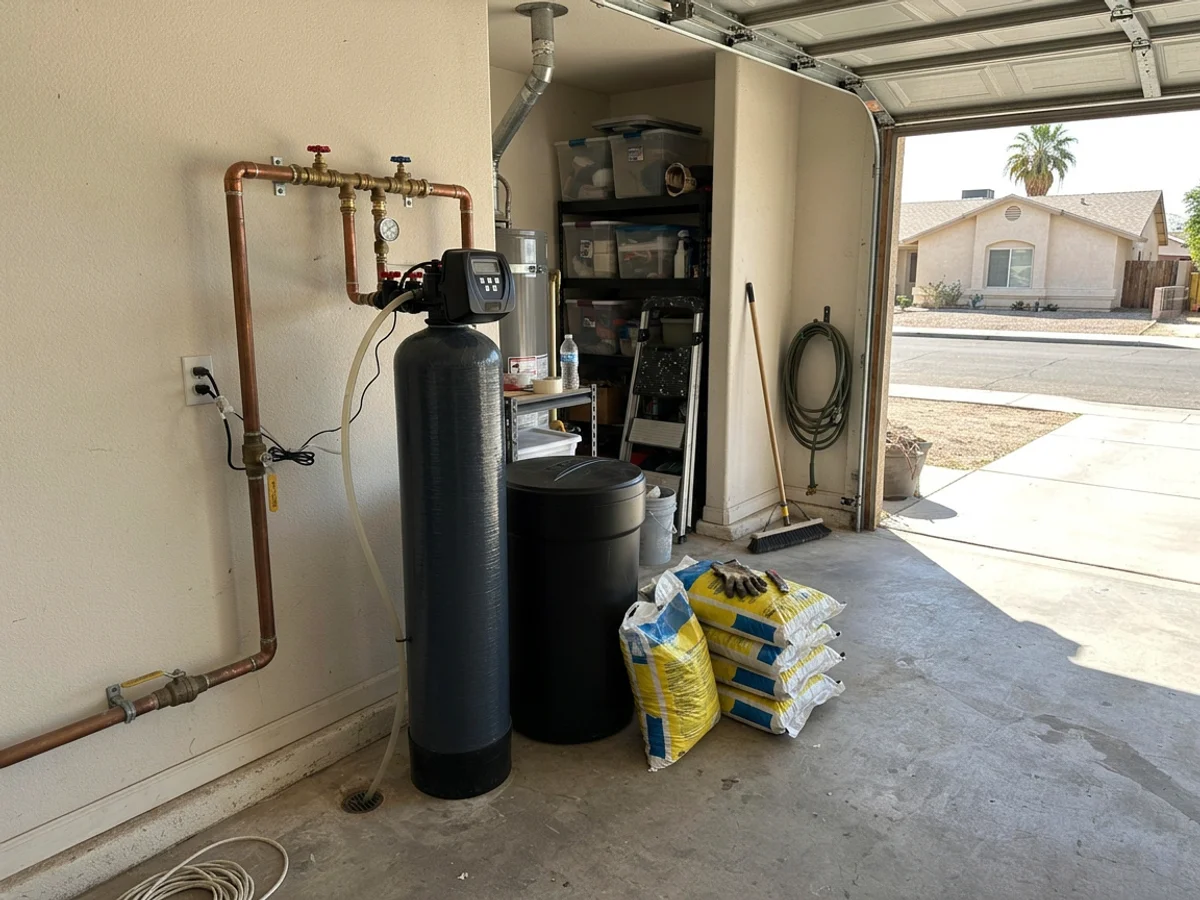
| Ion-exchange softener | Removes calcium and magnesium for the whole house, protecting pipes, heater, and fixtures | Improve drinking water taste on its own |
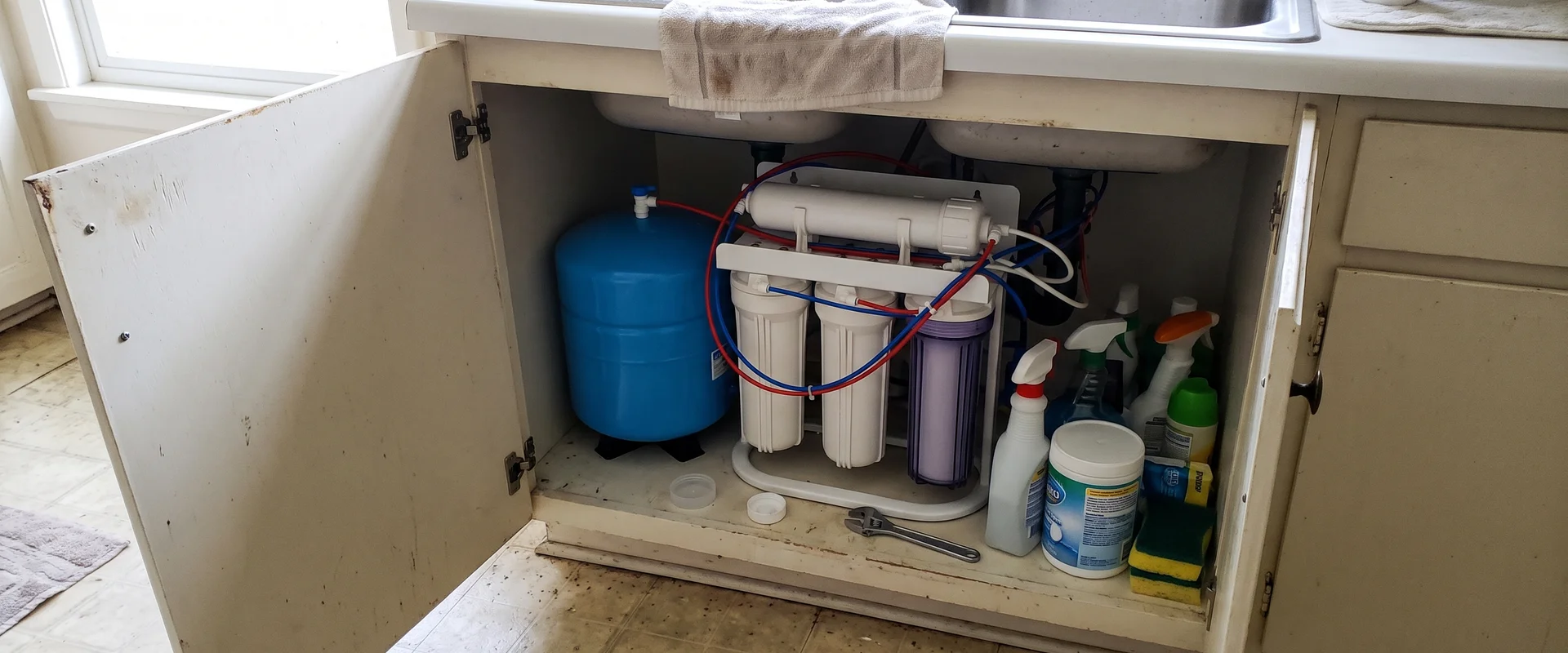
| Under-sink reverse osmosis | Reduces dissolved solids at one drinking tap for better taste | Protect the rest of the plumbing |
| Whole-house filtration | Reduces sediment, chlorine taste, and odor at every tap | Remove hardness |
| Salt-free conditioner | Changes how scale forms so it sticks less | Remove hardness; protection is limited in very hard water |
A sensible combination for many homes is a softener protecting the plumbing plus an RO tap in the kitchen for drinking and cooking. That covers both concerns without paying twice for the same result.
Sizing a Softener for Your Household
The math is straightforward. Daily water use multiplied by measured hardness gives the grains removed per day. The softener needs enough capacity to handle that load and still go several days between regenerations.
| Household Size | Approximate Daily Use | Sizing Note |
|---|---|---|
| 1 to 2 people | 150 gallons | Smaller units can work if hardness and usage allow |
| 3 to 4 people | 300 gallons | Hard water quickly rules out the smallest units |
| 5 or more | 400+ gallons | Higher capacity needed to avoid constant regeneration |
An undersized unit regenerates constantly, burns through salt, and wears out its resin early. An oversized one costs more without adding protection. Getting the capacity right matters more than the brand on the tank.
Where Softener Purchases Go Wrong
- Buying on price alone. The cheapest units are usually too small for hard river water.
- Leaving the factory hardness setting. The valve has to be programmed to your measured reading or it under-treats.
- Skipping the bypass valve. Without one, servicing the softener means shutting off water to the whole house.
- Hiding the brine tank. Salt bags are heavy. If the tank is awkward to reach, refills get skipped.
- Counting on a filter for scale. Carbon and sediment filters do nothing for hardness.
Softeners and RO in a Seasonal Home
Plenty of Bullhead City homes are winter homes that sit empty through the heat, and water treatment needs a little attention on both ends of the season. Before you leave, put the softener in bypass or vacation mode and close the main. When you return, run the taps for a few minutes, check the brine tank and salt level, and flush the RO faucet before drinking from it. RO filters need changing on schedule regardless of occupancy, and the membrane needs replacing every few years.
Once treatment is in place, the visible changes come quickly: less white crust, cleaner glassware, soap that lathers easily. The larger benefits arrive quietly over years, in a water heater that keeps its efficiency and faucets that stop needing new cartridges. You can request a free estimate and ask about any service call fee before booking, and our water treatment guides cover sizing in more detail.
Water treatment installs and service are available across Bullhead City, Fort Mohave, and Mohave Valley.