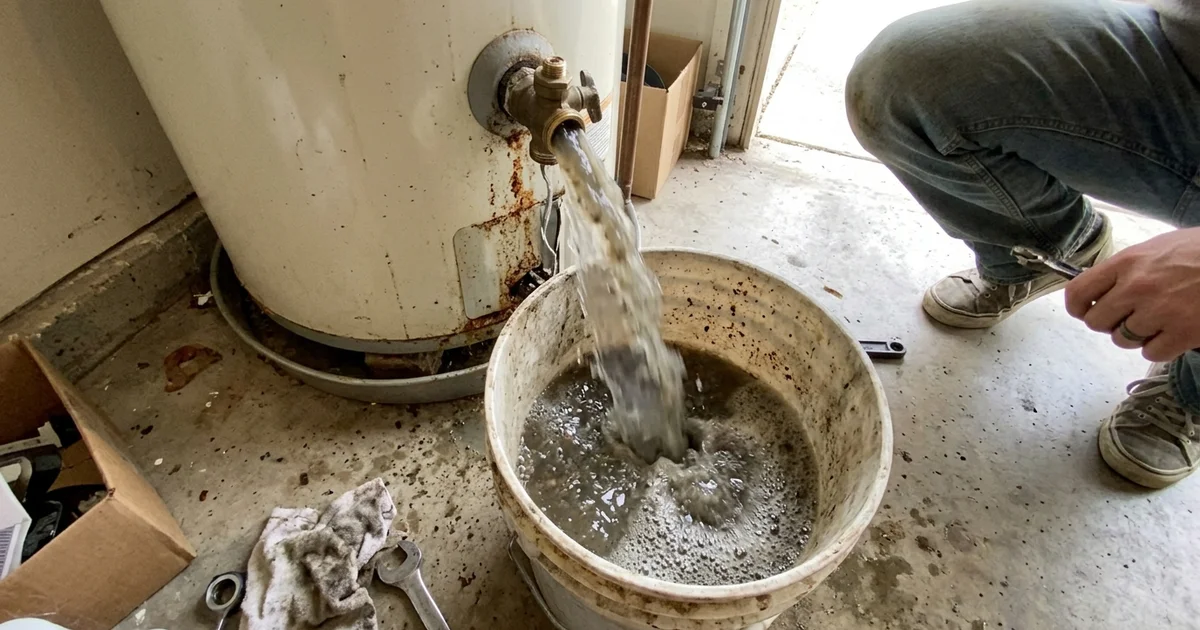
Talk to enough homeowners in Bullhead City and you hear the same story: the water heater was only a handful of years old when it started leaking onto the garage floor. That is not bad luck or a bad brand. It is the predictable result of three local conditions working on the same tank at the same time, and each one can be managed.
A quick self-check
Before the details, answer these about your own heater:
| Question | If yes |
|---|---|
| Has it gone more than a year without a flush? | Scale is likely building on the bottom |
| Does it sit in a garage or on an exterior wall? | It works harder through the summer |
| Is the house empty for part of the year? | Idle months add their own wear |
| Is there no softener upstream? | Every gallon brings more mineral in |
| Do you hear popping when it heats? | The scale layer already has real depth |
Two or more yeses and your heater is probably on the short-life track. Here is why.
Condition 1: Hard river water
The supply here is tied to the Colorado River, which carries a heavy load of dissolved calcium and magnesium. For your exact reading, test at the tap or check the city’s current water quality report. What matters for the heater is the chain reaction inside the tank:
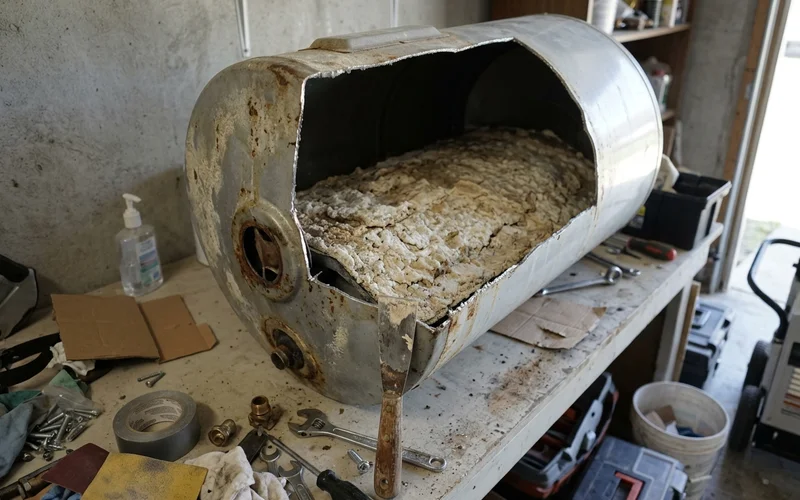
- Minerals drop out. Heat forces them out of the water, and they settle on the tank bottom, over the burner or around the lower element.
- Sediment hardens. Over months the loose layer bakes into a crust.
- The burner heats rock instead of water. Scale insulates the steel, so heat builds up in the metal.
- Recovery slows, burn time grows. You run out of hot water sooner and the bill creeps up.
- The steel overheats and corrodes from the inside, where nobody sees it.
- The tank leaks, usually at the bottom seam, often with little warning.
Condition 2: Desert heat
Summers here regularly pass 110 degrees, and water in the supply lines stays warm for months.
- Warm water is closer to dropping its minerals, so scale forms faster before the water is even heated.
- Garages bake. A heater in a garage or on an exterior wall cycles against daily demand all summer with no cool season. Heat pump water heaters also lose efficiency when the space around them gets that hot.
Condition 3: Idle months
Many local homes are winter homes, closed from spring to fall. What the owner does with the heater on the way out matters.
| Owner’s choice | What happens to the heater |
|---|---|
| Left on, normal setting | Keeps a full tank hot all summer for nobody, in a hot garage |
| Turned off, tank left full | Hard water sits for months; sediment settles and crusts; drain valve can stick |
| Set to vacation mode | Best of the three: low heat, minimal cycling |
Whichever you choose, flush the tank when you return and check for leaks before settling back in.
Warning signs, in the order they usually appear
- Popping or rumbling while heating. Our guide on water heater popping and rumbling sounds explains it.
- Hot water running out sooner. Rule out a broken dip tube too.
- A gas or electric bill creeping up with no change in use.
- Rust in the hot water only, a sign the anode is spent.
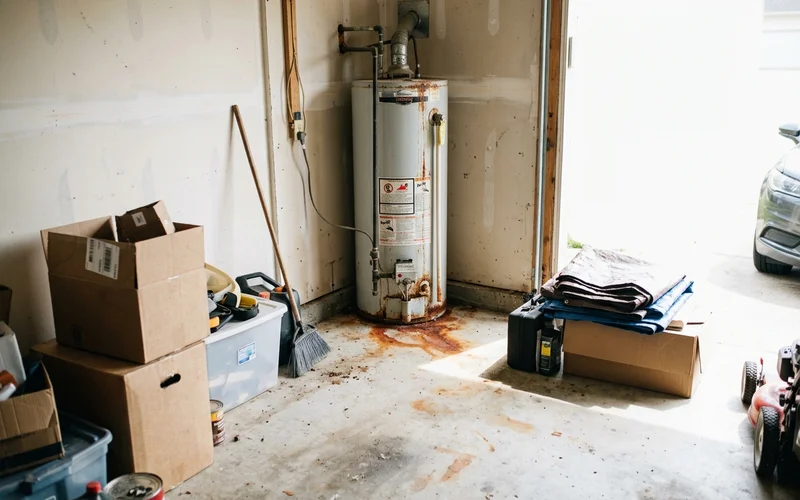
- Moisture at the base. Maybe a fitting or the relief valve, which are repairable. Maybe the tank, which is not.
Local expert insight
The life on the label assumes average water and routine service. Neither is automatic here. On this water, without a flush, the clock simply runs faster.
Three habits that close the gap
| Habit | How often | Why it works |
|---|---|---|
| Flush the tank | Every year | Removes sediment before it hardens into a fixed layer |
| Check the anode rod | Every few years | A spent rod leaves the steel unprotected |
| Treat the water upstream | Ongoing | A softener removes hardness before it reaches the tank |
Tankless owners have their own version: descale on a schedule set for this water, not the national manual. And when a heater does need replacing, size it to your household; an undersized tank cycles harder and scales faster. Ask whether a permit is needed and whether it is in the estimate.
Where to start
Our water heater repair and replacement service covers flushes, anode service, repairs, and replacement. For the root cause, see water softeners and reverse osmosis. Call Bullhead City Plumbing Pros at 928-555-0100 any hour, in English or Spanish, request a free estimate, and ask about any service call fee before booking.