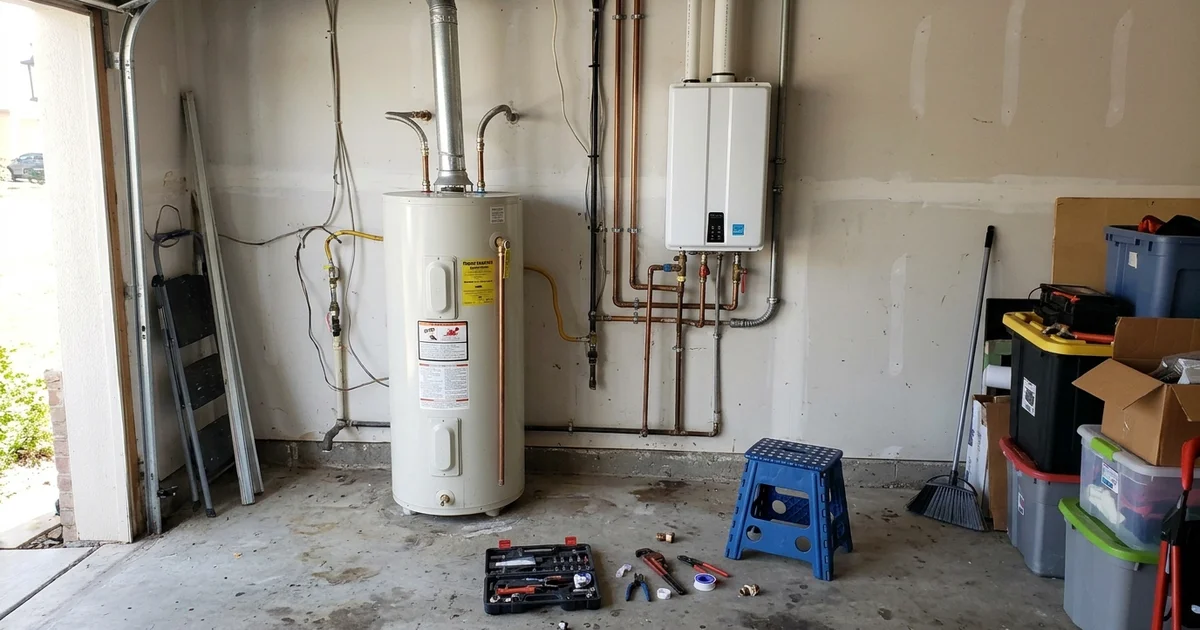
Most tank-versus-tankless comparisons stop at two points: upfront price and endless hot water. In Bullhead City a third factor carries just as much weight. The water is hard, and hard water wears the two designs out in completely different ways. Picking one is partly picking which kind of maintenance you would rather live with.
Two different ways to fail
Tanks fail slowly. Sediment collects on the tank bottom, insulates the burner, and lets the steel overheat. Eventually the tank corrodes through, usually at the bottom seam. It is a gradual decline you can manage with a yearly flush and periodic anode checks, and it forgives you if you run a little late.
Tankless units fail quickly when neglected. Scale builds inside the narrow passages of the heat exchanger. Efficiency drops, temperatures swing, error codes appear, and eventually the exchanger itself can fail. Skipped descaling shows up fast.
Nine criteria compared
| Criteria | Tank | Tankless |
|---|---|---|
| Upfront equipment and install | Lower | Higher, more if gas line or venting must be upgraded |
| Install complexity on a swap | Usually straightforward | May need a larger gas line, new venting, electrical work |
| Standby energy loss | Some, keeping the tank hot | Minimal, heats on demand |
| Hot water supply | Limited by size and recovery | Continuous at rated flow |
| Hard-water maintenance | Yearly flush, periodic anode check | Descaling at least yearly untreated, more with heavy use |
| Forgiveness of skipped maintenance | Fairly forgiving | Not forgiving |
| Typical failure | Tank leak | Scaled heat exchanger, error codes |
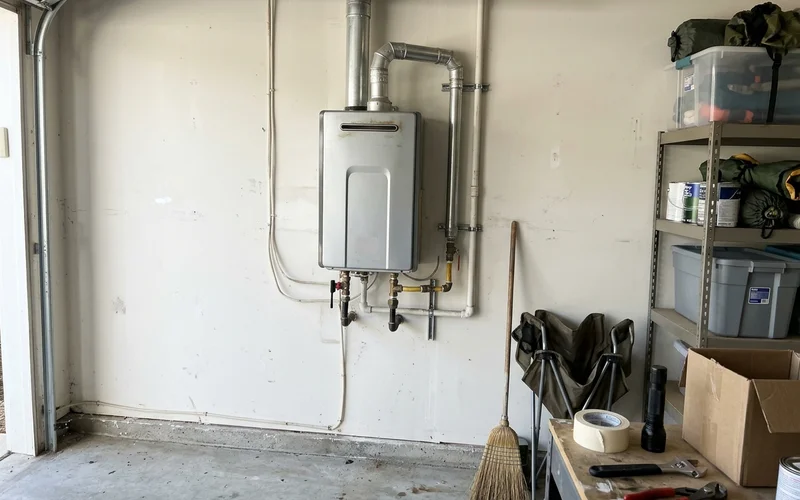
| Space | Floor space in garage or closet | Wall-mounted |
| Best fit | Light to moderate use, simple ownership | High demand, long ownership, committed to maintenance or softening |
How desert heat changes the picture
It helps tankless output. A tankless unit’s flow depends on how far it has to raise the water temperature. Incoming water here is warm for much of the year and mild even in winter, so the unit has less work to do and delivers more flow than a national sizing chart suggests. You may need a smaller model than you expected.
It hurts tanks in garages. A tank in a garage that passes 110 degrees cycles against daily demand all summer, and the warm, mineral-heavy water coming in is already close to dropping scale.
It affects part-year homes. A winter home sits idle through the hottest months. A tank can be set to vacation mode with little fuss. A tankless unit needs no standby heat at all, but it still benefits from descaling when you return.
Decision checklist
Choose a tank if most of these fit:
- You want the simplest, most forgiving upkeep.
- One or two people live there, or it is a part-year winter home.
- You need hot water back quickly and the current setup is a straight swap.
- You may sell within a few years.
- You are not planning to add a softener.
Choose tankless if most of these fit:
- Several people take back-to-back showers.
- You plan to stay many years.
- You already have, or will add, a softener.
- You will actually book descaling every year.
- You want the floor space back.
Local expert insight
A tankless unit on untreated hard water works well with a descaling schedule and better still with a softener upstream. Without either, it underperforms and fails early. That is not a knock on the technology; it is what this water does. See tankless descaling frequency for realistic intervals.
Sizing in brief
- Tank: look at your busiest hour. Two showers and a dishwasher in the morning set the demand, and tank size plus recovery rate has to cover it. Oversizing means paying to keep unused water hot.
- Tankless: add up the gallons per minute of fixtures likely to run together, then match that to the unit’s output at your temperature rise.
Before you book
Ask whether a permit is required for the replacement or conversion, and whether gas, venting, or electrical upgrades are included in the estimate.
Our water heater repair and replacement service covers gas, electric, and tankless. Call Bullhead City Plumbing Pros at 928-555-0100 any hour, in English or Spanish, request a free estimate, and ask about any service call fee before booking. Tell the automated assistant how many people live in the home and whether you have a softener.