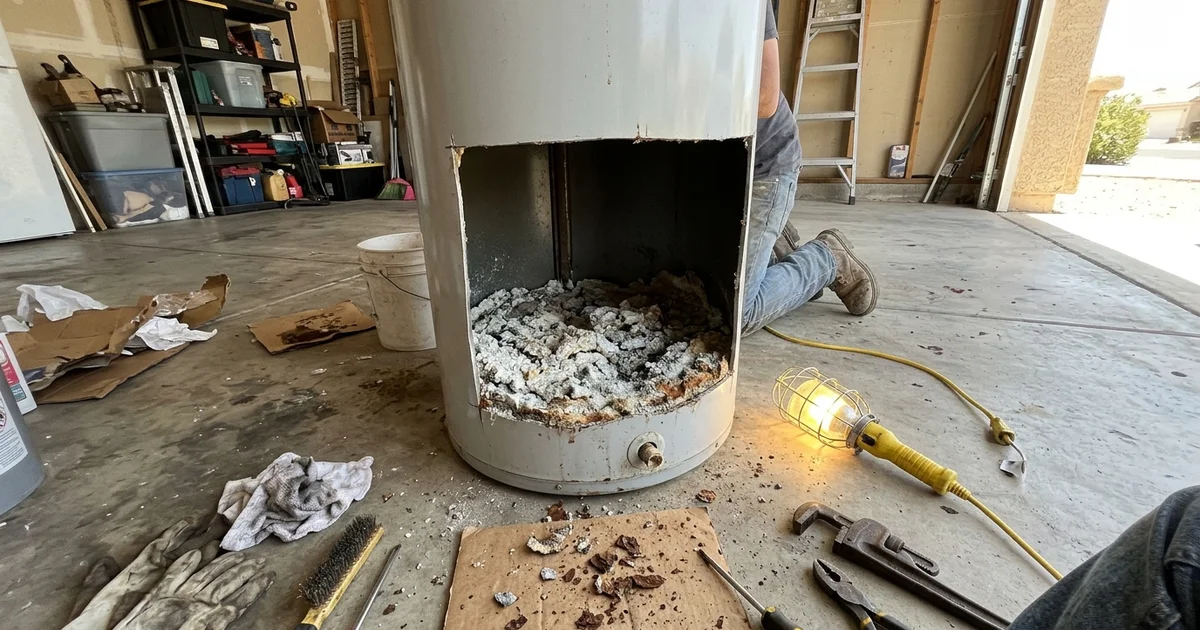
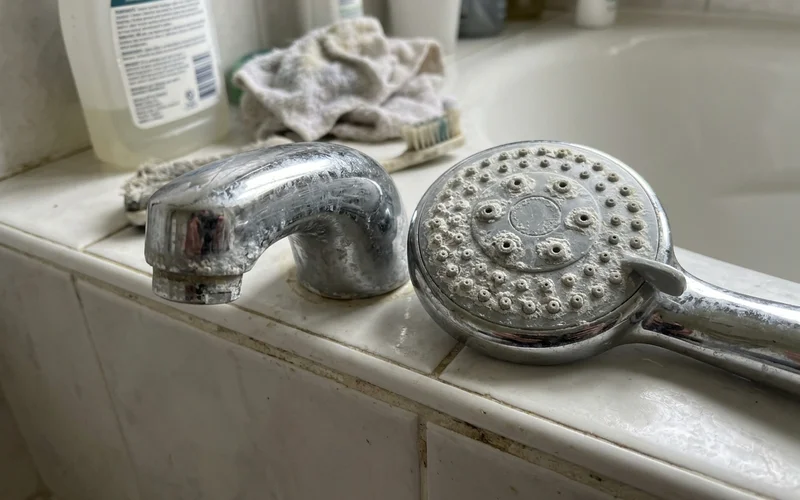
Spend a few months in a home here and you start to see it. A white ring on the shower head, cloudy spots on glasses, a faucet handle that grinds instead of glides. Those are the cheap, visible signs. The costly part is happening inside the water heater and behind the valves, where nobody looks until something fails.
This guide explains what “hard” means, how to get your own reading, and what the minerals in Bullhead City water do once they are inside your plumbing.
What “hard water” actually is
Hardness is the amount of dissolved calcium and magnesium in water. Rain is close to zero. Water that has traveled a long way through rock and soil picks up minerals along the route, and the Colorado River travels a very long way. By the time it reaches homes along this stretch of the river, it carries a heavy mineral load. Plainly put: the water is hard.
Hardness is not dirt and not contamination. The water can be perfectly safe to drink and still be hard on everything it passes through.
Get your own number before you buy anything
Hardness varies with the source, the season, and the system serving your street, so do not rely on a number you heard from a neighbor or a salesperson. Get it yourself:
- Read the report. The city publishes a water quality report, and the current one lists hardness. If your home is served by a different water provider, use that provider’s report.
- Test at the tap. A hardness strip or drop-count kit costs little and takes a couple of minutes. Test the cold kitchen tap, ahead of any softener or filter.
- Convert the units. Reports often use milligrams per liter (mg/L). Softener sizing uses grains per gallon (gpg). Divide mg/L by 17.1 to get gpg.
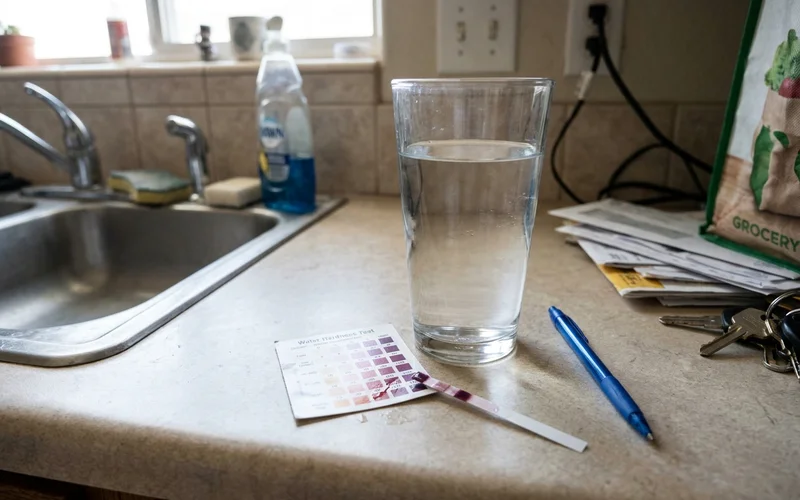
Write the number down. It is the input for every decision in the rest of this guide.
Why minerals leave the water
Dissolved minerals stay in solution while water is cool and moving. Two things push them out as solid scale:
- Heat. Warm the water and the minerals precipitate.
- Evaporation. Let water dry on a surface and the minerals stay behind.
That tells you where to look: anything that heats water, and anything that gets wet and dries.
Where the damage lands, most expensive first
| Rank | Where | What happens | First sign |
|---|---|---|---|
| 1 | Tank water heater | Scale crusts the tank bottom between the burner and the water; steel overheats and corrodes | Popping or rumbling, shorter hot water |
| 2 | Tankless heater | Narrow heat exchanger passages scale up | Temperature swings, error codes |
| 3 | Shutoff valves | Scale cements stems of valves that sit unused | A valve that will not turn during a leak |
| 4 | Faucet cartridges and toilet parts | Sealing surfaces get scored or crusted | Drips, stiff handles, running toilets |
| 5 | Dishwashers and washers | Heating elements scale | Film on dishes, longer cycles |
| 6 | Shower heads and aerators | Openings clog with crust | Weak or sideways spray |
The water heater is the big one. It is the reason heaters on this water so often fall short of their rated life. Our water heater repair page covers what to do when one starts showing the signs.
What the desert heat adds
Summers here regularly pass 110 degrees, and water in the supply lines runs warm for months. Warm water is already closer to the point where minerals drop out, so scale forms faster at every stage. Water heaters in garages and on exterior walls work harder through the summer, too, cycling in a hot space with no cool season to rest.
Winter homes have their own version of the problem. Water left sitting in a tank or a fixture for months can leave deposits behind, and valves that never get turned have more time to seize.
Your options, from lightest to strongest
| Step | What it does | What it does not do |
|---|---|---|
| Clean aerators and shower heads | Restores flow at that fixture | Nothing for the heater or valves |
| Flush the water heater yearly | Removes loose sediment before it hardens | Does not stop new scale |
| Check the anode rod every few years | Protects the tank from corrosion | Does not address scale |
| Descale a tankless unit on schedule | Keeps the heat exchanger clear | Has to be repeated |
| Salt-free conditioner | Reduces how much scale sticks | Does not remove hardness |
| Whole-home softener | Removes hardness before it reaches anything | Does not purify drinking water |
| Reverse osmosis at one tap | Better drinking and cooking water | Does not protect the rest of the house |
On hard water, a correctly sized softener is closer to preventive maintenance than a luxury. Correct sizing depends on the reading you took above and how much water your household uses. Our page on water softeners and reverse osmosis explains how that works.
Local expert insight
If your faucets and shower heads crust over quickly, assume the inside of your water heater looks similar. The fixtures are the warning; the heater is where the money is.
The bottom line
You cannot change what comes out of the river, but you can decide how much damage it does. If you are seeing crust on fixtures or hearing the water heater pop, Bullhead City Plumbing Pros answers at 928-555-0100, any hour, in English or Spanish, and routes your details to a local plumber. Request a free estimate and ask about any service call fee before booking.